
Description
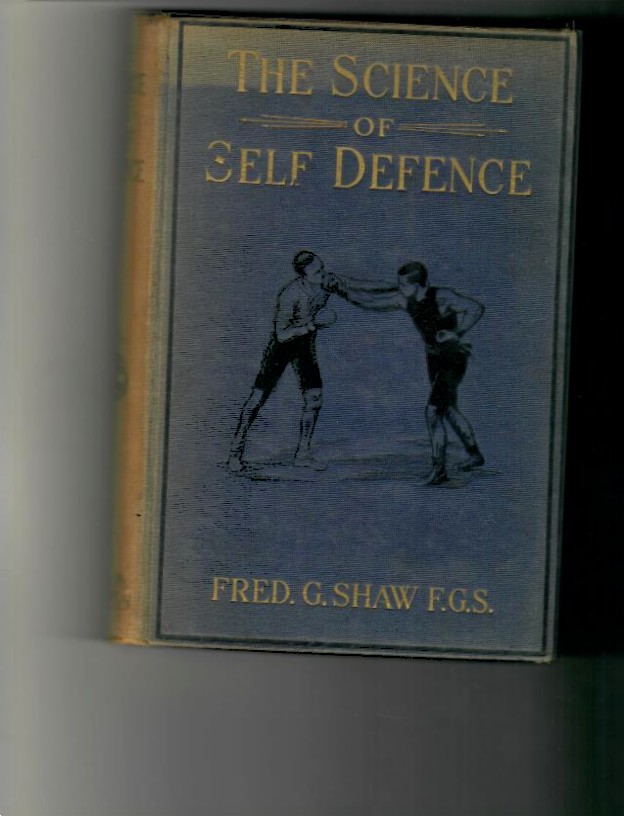
Shaw, Fred ‘The Science of Self Defence’ 1919 1st edition. 184-pages. Spine is badly sunned and pages 70-74 are loose. Otherwise, the book is in good to good + condition. Straight, very clean internally. Contents: Introduction and the Johannesburg Fight, Considerations of Boxing Past and Present, Terms and Methods Used in Boxing, How to Become a Scientific Boxer, Explanation of and Commentary on – The Illustrations, Practical Advice to the Amateur, Evils Introduced by American Professional Boxing, In-Fighting Versus Fighting-In, Modern Boxing and the A.B.A., The Referee and Professional Boxing, The Difficulties of Refereeing, Evil Influences Affecting Modern Professionalism – Gigantic Purses – Bloated Gate Returns – Impotent Refereeing and Unscientific Boxing, The Verdict of Public Opinion, Narratives Illustrating the Value of In-Fighting.
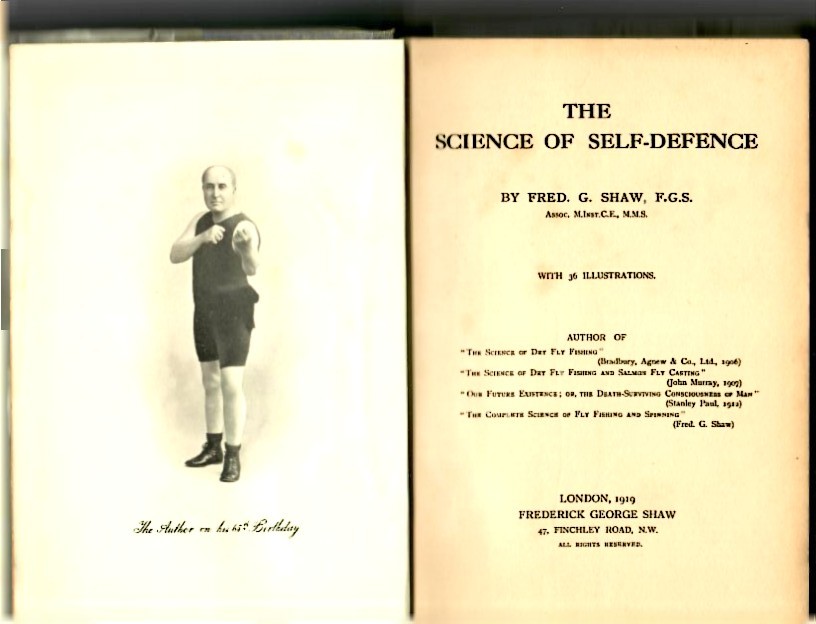
Shaw, Fred G. ‘The Science of Self Defence’ 1919 1st ed. 184-pages. INSCRIBED on the photo of Shaw opposite the title page: “Dear Sir. Thomas, please accept this book with my sincerest wishes for your heath & prosperity, George Shaw March 25/23” Some sunning to spine and bumped corners, else good condition, straight and very clean internally.
The Science of Self-Defence is a rare 184-page instructional boxing and physical culture treatise written and self-published by the multi-talented British author, engineer, and world-champion fly-caster Fred G. Shaw (Frederick George Shaw, F.G.S.). Published as a hardcover first edition in 1919 from his personal address at 47 Finchley Road, London, this volume is considered a foundational early-20th-century British boxing collectable.
The book represents a highly meticulous, analytical approach to boxing, leveraging the author’s background in science and geometry to treat prizefighting as an exact discipline rather than a chaotic brawl.
• The Physics of Boxing: Shaw provides an in-depth guide to successful boxing by applying proven physical, mechanical, and mental methods. He focuses heavily on leverage, geometric angles of defense, balance, and kinetic force generation.
• Instructional Imagery: The text is richly illustrated with 36 photographic plates and explanatory diagrams outlining footwork matrices, correct guard stances, and punch trajectories.
• Historical References: It analyzes the strategic choices made in historic professional fights of the early 20th century to emphasize its tactical lessons.
• National Sporting Club Influence: Written with a deep reverence for the strict rules and sportsmanship governing British boxing, the book closely aligns with the traditions of London’s historic National Sporting Club.

Reviews
There are no reviews yet.