
Description
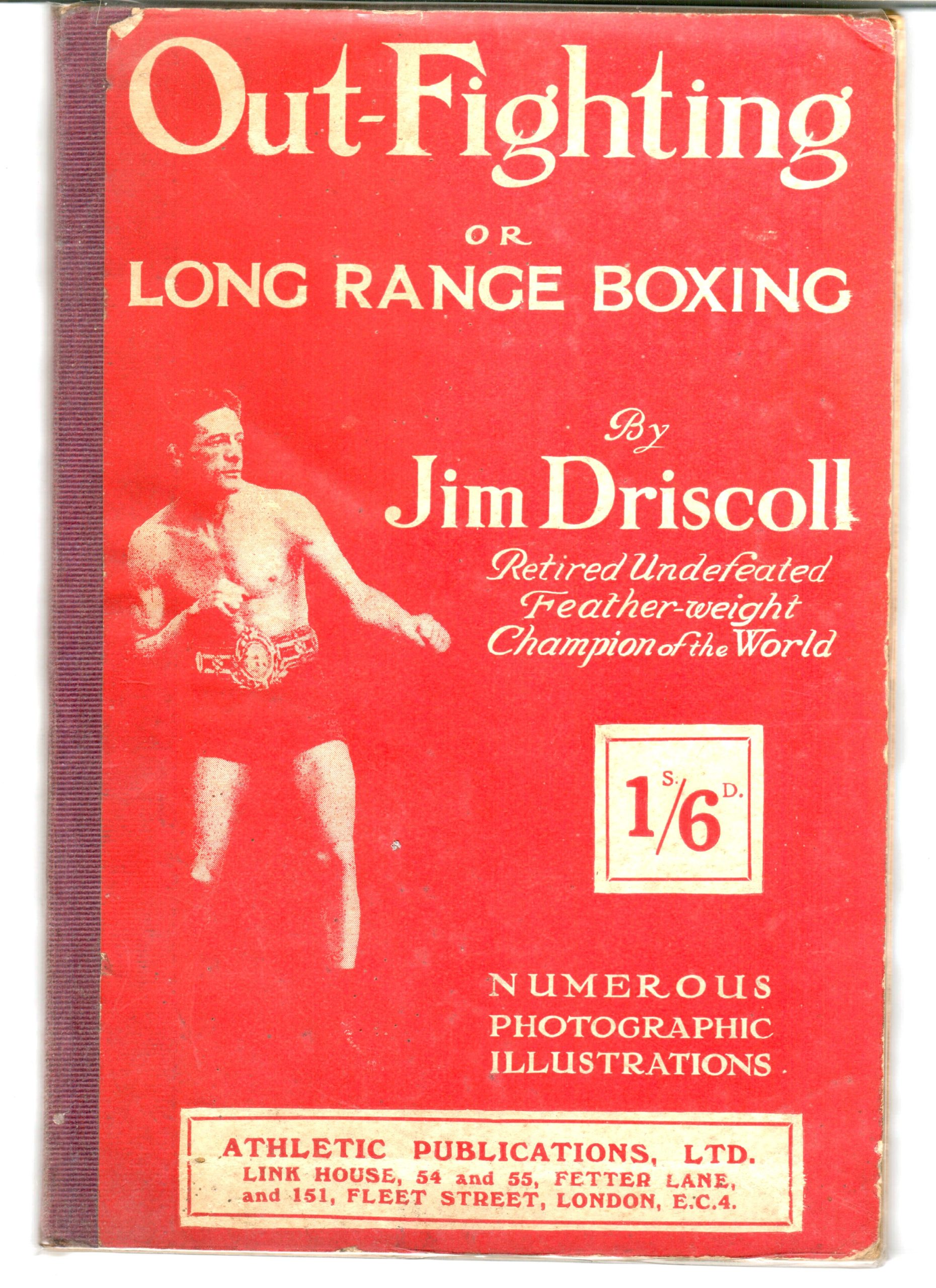
Driscoll, Jim ‘Out-Fighting or Long Range Boxing’ c1921. Athletic Publications Ltd., Link House, 54/55, Fetter Lane. Plastic encased card covers. 76-pages plus ads. Good+ condition. I assume this is the later 1921 re-issue as Hartley’s Boxing Bibliography says it was originally published by Ewart, Seymour and Co., Ltd. Still over a 100-years old and a nice old book.
The early 20th-century hardcover edition of Out-Fighting or Long-Range Boxing by Jim Driscoll published by Athletic Publications Ltd. is a 76-page specialist instructional guide. While the manual was originally written and published around 1914 by Ewart, Seymour & Co., Ltd., this subsequent Athletic Publications print run served to keep the legendary featherweight’s scientific principles in distribution for a new generation of British boxers.
Book Details:
• Author: Peerless Jim Driscoll (Retired undefeated Commonwealth and British Featherweight Champion)
• Publisher: Athletic Publications Ltd., London (Note: Athletic Publications took over many of the classic sports and physical culture titles originally published by Ewart, Seymour & Co.).
• Publication Year: Circa 1920s / early 1930s (Typically issued without an explicit print date)
• Format: Small hardcover pocket octavo (measuring roughly 7 ¼” x 4 ¾”), bound in cloth-covered boards.
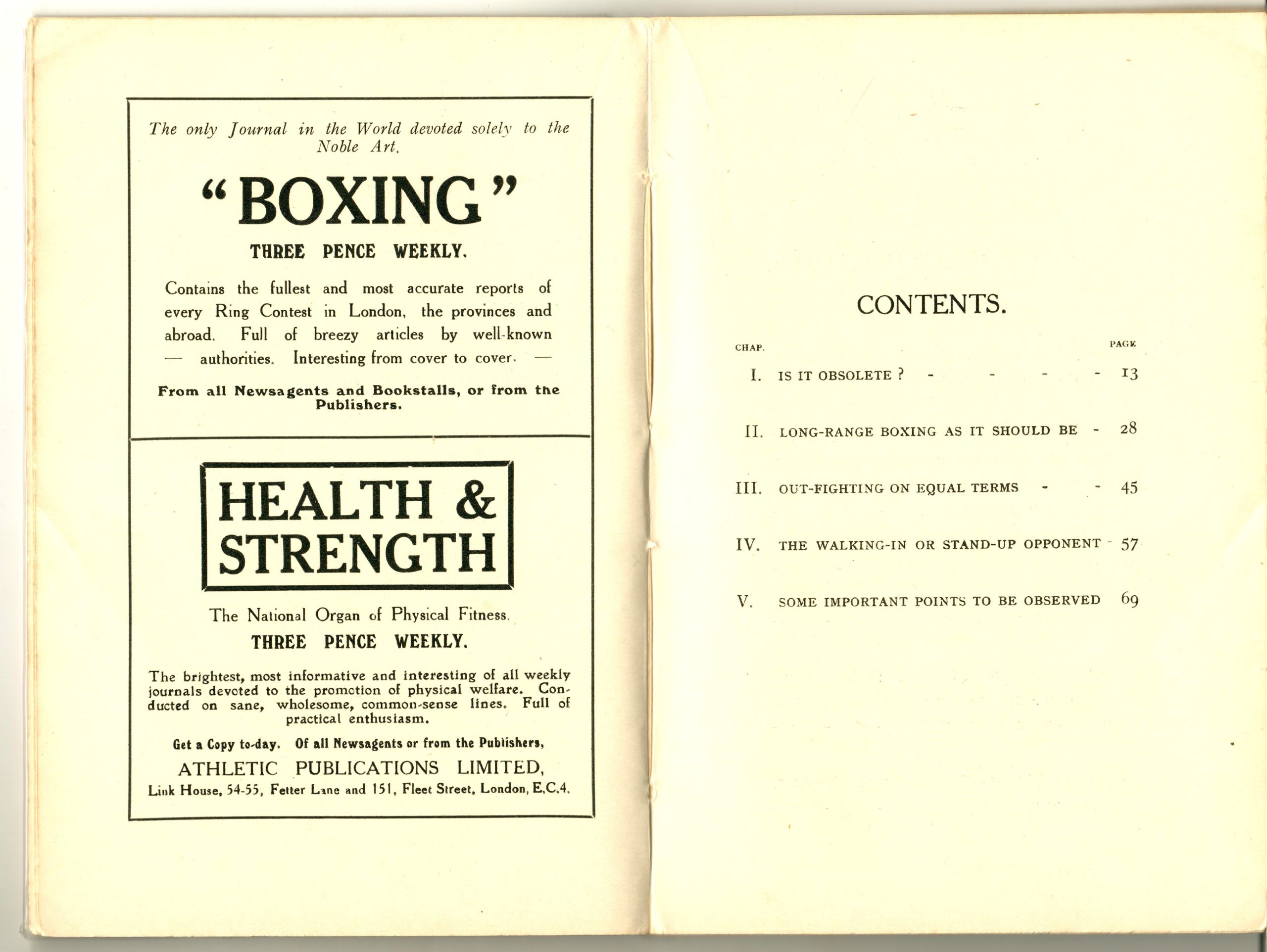
• Length: 76 pages of core text, usually followed by several pages of publisher catalogs and sporting advertisements.
Content & Overview:
• The Art of Distance: Written as a follow-up to his definitive work The Text Book of Boxing, Driscoll explicitly designed this manual to correct what he viewed as a major failure in contemporary gym instruction—the total neglect of out-fighting and long-range tactical geometry.
• Mastering the Lead: Widely revered as one of the finest defensive boxers and masters of the straight left jab in ring history, Driscoll uses the book to teach the mechanics of distance control. He details how to use precise footwork to keep aggressive in-fighters at bay, how to seamlessly slip rushing attacks, and how to maximize punch extension without losing balance.
• The Intellectual Fighter: Interspersed with technical lessons, Driscoll shares his broader philosophies regarding fight psychology, the divergence of boxing styles, and observations on the evolution of international prize ring rules.
• Illustrations: The text functions as an indispensable visual archive of classical pre-war British pugilism, profusely illustrated with over 40 photographs. These rare archival plates feature Driscoll himself posing in a studio ring to model exact body alignment, proper extensions, and traditional defensive guards.