
Description
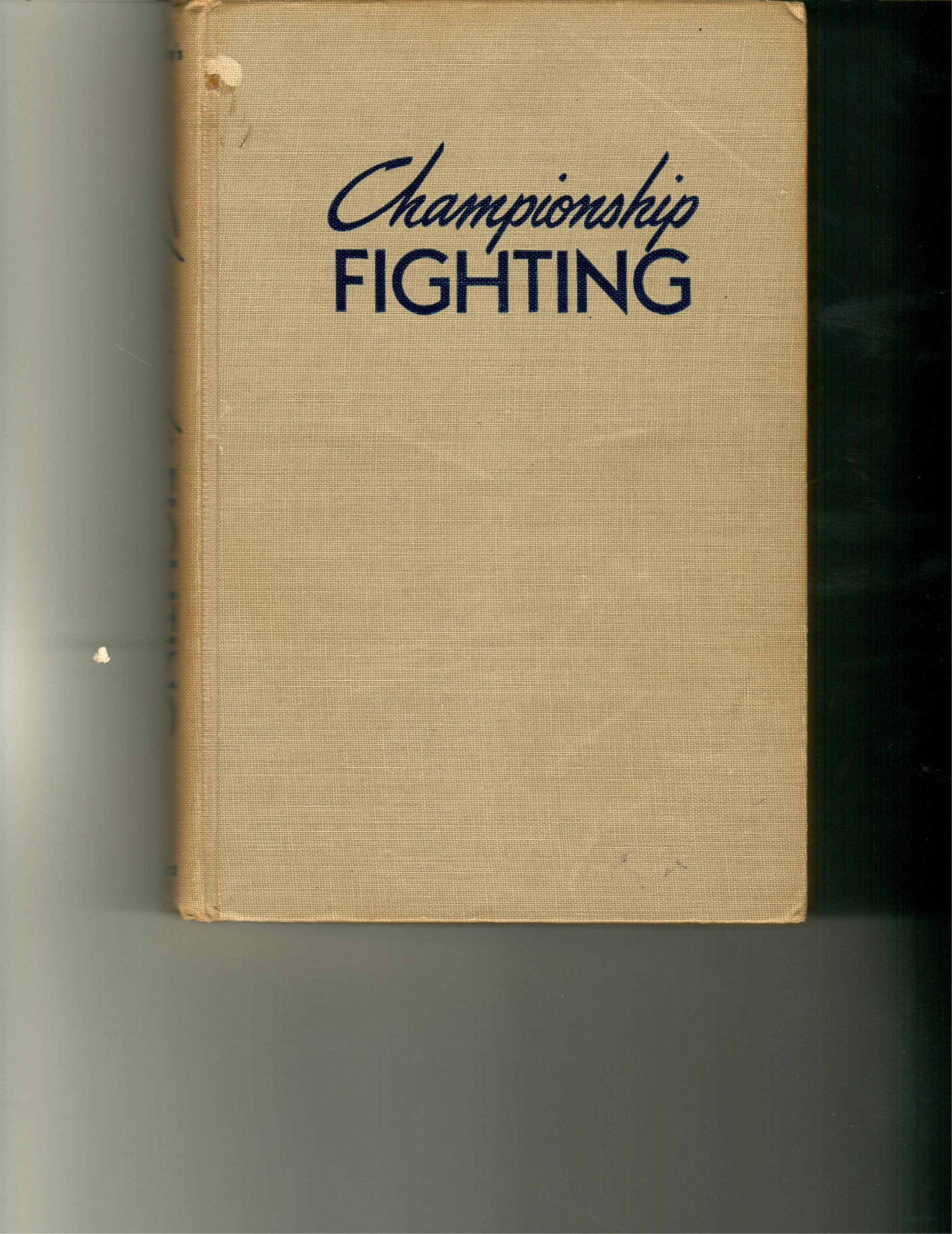
Dempsey, Jack ‘Championship Fighting’ 1950 2nd printing published by Prentice Hall, New York. Chapters: Explosives at Toledo, Good and Bad Toledo Aftermaths, Punchers are Made Not Born, Why I Wrote this Book, Differences Between Fist-Fighting and Boxing, You’re the Kayo Kid, What Is a Punch? The Falling Step, The Power Line, Relaying and Exploding, Stance, Footwork, Range, Straight Punching from the Whirl, Purity in Punching, Hooking, Uppercuts, Punch Ranks First, Your Sparmate, General Defense and Blocking, Deflection, Evasion, Feinting and Drawing, Training, How to Watch a Fight. 264-pages. A tiny ding in the upper left corner of the front cover, a couple indents on the rear cover as pictured. Otherwise, in good condition, straight, very clean, tight binding. No dust jacket.
The 1950 first edition, second printing hardcover of Championship Fighting: Explosive Punching and Aggressive Defense by Jack Dempsey is a 264-page masterclass manual on combat mechanics published in New York by Prentice-Hall, Inc.. Written by the legendary “Manassa Mauler” with editorial assistance from veteran sports writer Jack Cuddy, this text remains celebrated as arguably the finest, most scientifically precise manual on power generation ever written.
Book Details:
• Author: Jack Dempsey (World Heavyweight Boxing Champion, 1919–1926)
• Editor: Jack Cuddy
• Publisher: Prentice-Hall, Inc., New York
• Publication Year: 1950 (Stated First Edition, Second Printing)
• Format: Hardcover octavo (8vo), bound in a dark maroon/burgundy cloth with white stamped lettering across the spine and front board. It was issued in a bold pictorial dust jacket typically titled “Jack Dempsey’s Championship Fighting”.
• Length: 264 pages
Content & Overview:
• The Physics of Boxing: Moving past standard hand-waving training advice, Dempsey reverse-engineered his own devastating punching power. He uses clear, basic physics to explain that true knockout power does not originate from muscle mass or just twisting the hips, but from forcing one’s entire body weight into fast, concentrated motion.
• Core Concepts Introduced: The textbook breaks down combat into definitive, revolutionary concepts that altered martial arts instruction forever, including:
• The “Falling Step”: Utilizing gravity and forward momentum to explode a fighter’s body mass behind a straight lead punch.
• The “Power Line”: Directing a punch straight through the skeletal structure—aligning the shoulder down to the ring finger and pinky knuckles—to prevent injury and maximize impact force.
• Instructional Scope: Across 25 comprehensive chapters, Dempsey instructs readers in the foundational mechanics of proper stance, intricate footwork, feinting, blocking, parrying, and aggressive slipping. He tailors the advice to both the prize ring and the raw, rapid necessities of civilian self-defense.
• Illustrations: The publication is richly diagrammed with 128 black-and-white technical drawings and sketches executed by artist Ed Igoe. These visual plates map out step-by-step weight transfer lines, body angling, and defensive head movement.
• Legacy: The text is universally considered a blueprint of combat sports literature. Its technical principles were so widely admired that Bruce Lee later used Dempsey’s concepts of straight punching and weight transfer as foundational components when constructing his martial art of Jeet Kune Do.

Reviews
There are no reviews yet.