
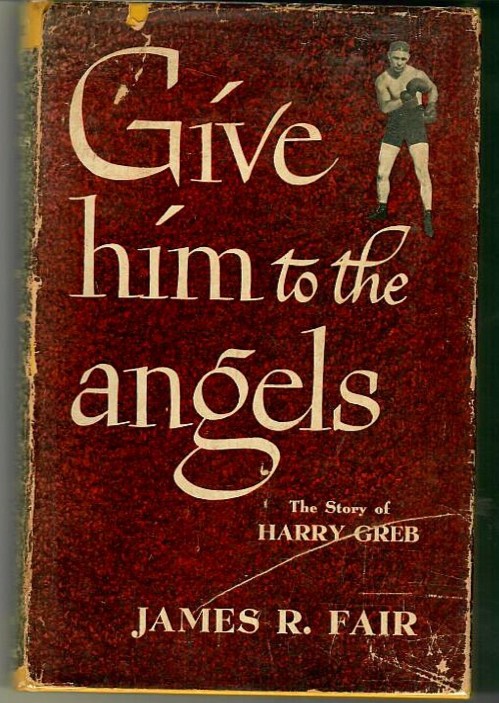
Description
Fair, James ‘Give Him to the Angels. The Story of Harry Greb’ 1946 1st edition, 184 pages. VG in good worn scarce non-price clipped mylar protected dust jacket that is missing a dime size piece out of the top of the jacket’s spine. Title page and picture of Greb opposite are heavily foxed.
The Story of Harry Greb by James R. Fair chronicles the chaotic, fast-paced life of legendary American professional boxer Harry Greb, nicknamed “The Pittsburgh Windmill” or “The Human Windmill.” Greb, who held the American Light Heavyweight Title and the World Middleweight Title during the 1920s, is widely regarded as one of the toughest, most relentless fighters in boxing history.
The book outlines Greb’s unorthodox and ferocious style in the ring. He was famous for throwing a non-stop barrage of punches and frequently utilizing dirty tactics that were commonplace at the time—such as using his elbows, kneeing, and thumbing opponents’ eyes.
A major focal point of his career detailed in the book is a 1921 bout against Kid Norfolk, where a thumb to the eye left Greb completely blind in his right eye. Remarkably, Greb kept this a total secret from boxing commissions, doctors, and opponents, continuing to fight at the highest level with only one functional eye for several years.
Fair captures Greb’s colorful and frantic lifestyle. Unlike his contemporaries, Greb hated traditional training workouts. Instead, he preferred to stay in shape by boxing constantly—sometimes scheduling three fights in a single week. He abstained from drinking and smoking, but he was infamous for his love of nightlife, endless partying, and chasing women.
The biography details his legendary clashes against all-time greats, including his famous 1922 victory over the previously undefeated Gene Tunney—handing Tunney the only loss of his entire career.
The book concludes with Greb’s sudden and tragic death in 1926 at the age of 32. Having just retired, Greb went to a plastic surgeon to repair a bent nose from his many fights and ease breathing issues. He unexpectedly died on the operating table due to complications and infection following the procedure.