Description
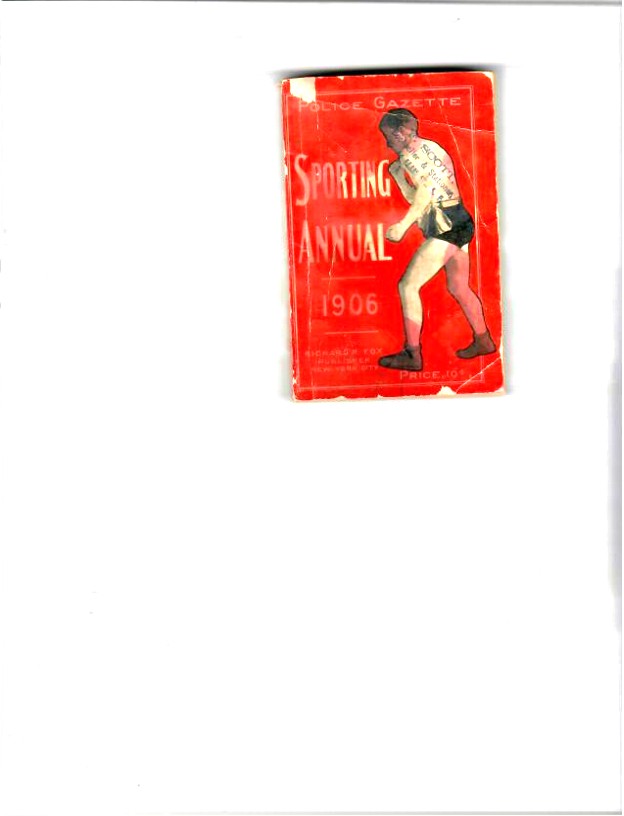
Fox, Richard K. – The Police Gazette Sporting Annual 1906. 171-pages plus another 19-pages of advertisements. Missing the original rear cover, some loss of paper to the spine and the front cover has a couple of tiny chips as pictured. Good plus internally.
The Police Gazette Sporting Annual 1906 (frequently designated as the 1906–1907 edition) is a vintage sports record book and almanac compiled by editor Sam C. Austin and published by Richard K. Fox. Serving as a definitive analytical record of the previous year’s sporting achievements, this softcover guide captures a pivotal era in American sports history.
The original 1906 volume typically features 171 text pages, followed by an unnumbered back-page section dedicated to illustrative advertisements for Fox’s sensational athletic gear, physical culture books, and specialized tabloids.
Detailed Description:
• Pugilistic Record Dominance: True to the mission of The National Police Gazette, which was the unofficial governing authority and promoter of championship prizefighting at the time, boxing takes up the vast majority of the text. The book covers the complete professional fight records, career timelines, and weight classifications of major early-1900s fighters like James J. Jeffries, Bob Fitzsimmons, Tommy Burns, and emerging contenders.
• Comprehensive Multi-Sport Metrics: Beyond boxing, it functions as a statistical matrix for turn-of-the-century popular athletics. It features historical performance logs, speed records, and championship schedules for baseball, bicycling, horse racing (trotting), track and field, and rowing.
• Layout & Visuals: The pages are tightly packed with statistical tables interspersed with signature black-and-white portraits, active sports engravings, and halftone photographic inserts profiling dominant athletes and strongmen.
• Format & Fragility: It is a pocket-sized softcover bound in highly delicate, illustrated paper wraps. Like other entries in the series, it was printed on cheap, acidic pulp paper aimed at a wide consumer audience and commonly distributed to barrooms and barber shops.