
Description
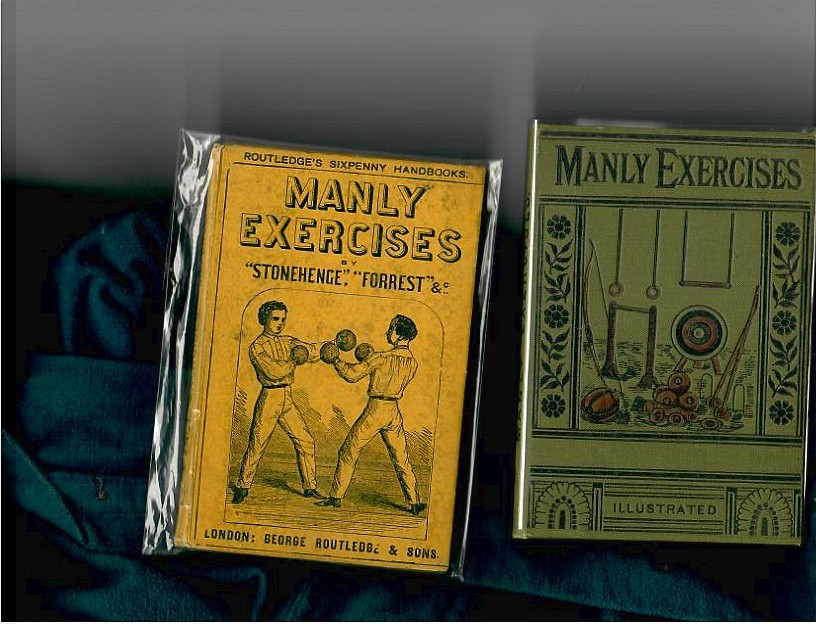
Forest, Stonehenge ‘The Handbook of Manly Exercises; Comprising Boxing, Walking, Running, Leaping, Vaulting, Etc., With Chapters on Training for Pedestrianism and Other Purposes.’ The opening chaper is titled ‘Boxing’ and covers pages 7 thru 18. 1865 1st ed. Published by George Routledge & Sons, London. 64-pages. 3 3/4″ x 5 1/2″ Good +. Very scarce. . Another with different covers of the same size and number of pages that has a printed reference to the Routledge’s Sporting Annual for 1883 so perhaps this is a later edition of the same book and is in VG condition. $150 each.
The Handbook of Manly Exercises (originally published around 1864–1865) is a pocket-sized, 64-page instructional guide published as part of Routledge’s Sixpenny Handbooks series. The book was written under the pseudonyms “Stonehenge” (the pen name for John Henry Walsh, a famed sportswriter and editor of The Field) and “Forrest” (the pen name for Reverend John George Wood, a prolific popularizer of natural history and athletics).
Key Elements & Structure
Pedestrianism and Athletic Sports: The manual acts as a concise Victorian guide to outdoor tracking events and general physical conditioning. It outlines the structural rules, techniques, and distinct forms of foot-racing, walking, running, leaping, and vaulting.
The Art of Boxing: A significant portion of the book features heavily illustrated woodcut instructions dedicated to the art of self-defense. It details standard athletic stances, punches, parries, and ring strategy of the mid-19th century bare-knuckle era.
Victorian Training Regimens: True to its time, the book outlines strict conditioning methods for “pedestrianism” (competitive walking/running). This includes advice on severe dietary constraints, sleep schedules, and how to treat standard training injuries and accidents.
Physical & Moral Philosophy: Like Donald Walker’s famous Manly Exercises manual that preceded it, the book promotes the 19th-century British ideal of “Muscular Christianity”—the belief that vigorous physical training builds an elegant form, proper posture, moral discipline, and robust health.


Reviews
There are no reviews yet.