Description
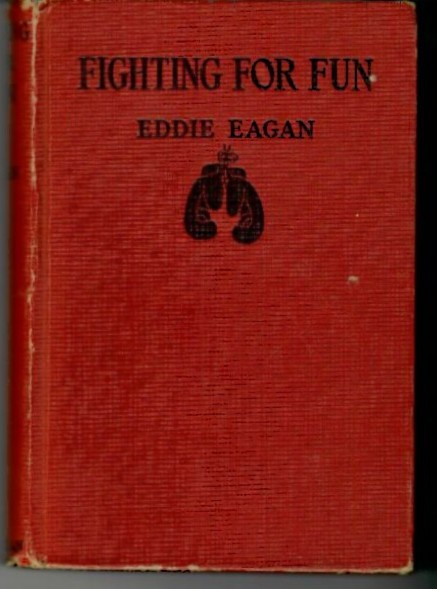
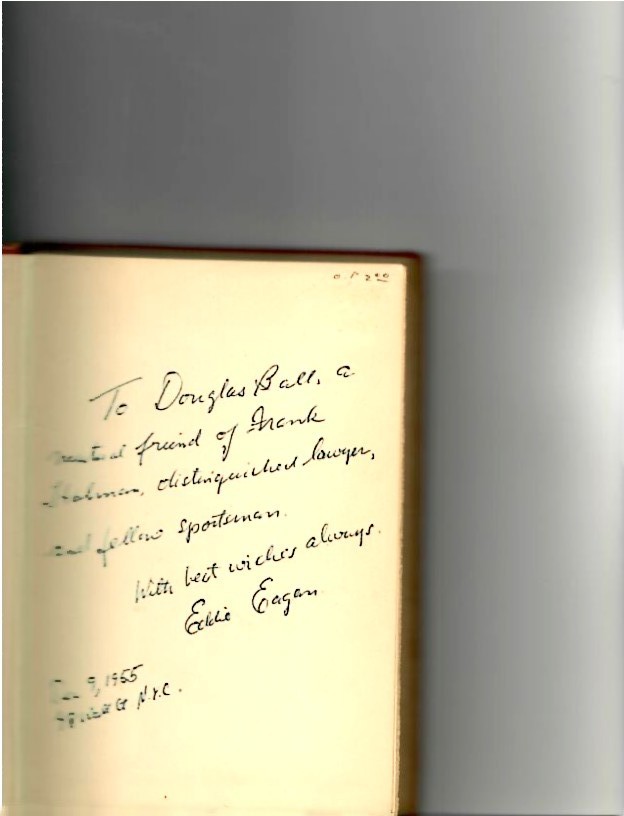
Eagan, Eddie ‘Fighting for Fun. The Scrap Book of Eddie Eagan’ 1944 reprint of the 1932 1st edition. Publisher, The Macmillan Company, New York. 300-pages. INSCRIBED by Egan on frontispiece: “To Douglas Ball, a mutual friend of Frank Holman, distinguished lawyer and fellow sportsman. With best wishes always, Eddie Eagen. Dec 9, 1955. 48 Wall Ct. N.Y.C.” Eagan won the AAU heavyweight title in 1919, the American gold medal light-heavyweight boxer in the 1920 Olympics, the Amateur Boxing Association heavyweight title in 1923, and a gold medal winner in the four-man bobsled at the 1932 Winter Olympics. He was also the middleweight champion of the American Expeditionary Forces. Good condition, straight with tight binding. Bumped at the head and foot of the spine. Front hinge is loosened but intact.
Fighting for Fun: The Scrap Book of Eddie Eagan is a biographical and historical boxing memoir written by Edward Patrick Francis Eagan. Originally published in 1932, the 1944 reprinted hardcover edition by The Macmillan Company serves as a “fourth printing” of his journey. It explores his strict adherence to amateur athleticism, his remarkable rise through the boxing world, and his personal observations of legendary heavyweight champions.
The book functions as an autobiographical “scrapbook” documenting Eagan’s life and philosophy in the ring. Inspired by childhood advice to always “fight for fun,” Eagan famously vowed never to turn professional or profit financially from boxing. The text details how he maintained this amateur status while climbing to the highest echelons of the sport. The narrative is structured around major eras of his fighting development and historical boxing deep-dives:Early Boxing Days & World War I: The book covers Eagan’s early training in Colorado, his first tournaments, and his enlistment as an artillery lieutenant in World War I, where he won the middleweight title of the American Expeditionary Forces.
Collegiate and Olympic Triumph: It chronicles his time at Yale University, winning the AAU heavyweight title, and his ultimate amateur achievement—capturing the 1920 Olympic Light-Heavyweight Gold Medal in Antwerp. It also features his time as a Rhodes Scholar at the University of Oxford, where he became the first American to win the British amateur boxing championship.
Insights on Boxing Legends: A significant portion of the book is dedicated to Eagan’s personal interactions, historical critiques, and experiences sparring with prominent fighters. Individual chapters provide unique technical and psychological insights into legendary figures including: John L. Sullivan, Jim Corbett, Theodore Roosevelt (and his relation to Mike Donovan), Bob Fitzsimmons, James J. Jeffries, Jack Dempsey (with whom Eagan sparred), Gene Tunney.
Significance of the Author: Though the book itself strictly chronicles his boxing career up to the early 1930s, the 1944 reprint carries notable historical weight because of what Eagan achieved shortly after drafting it. In 1932, he won a gold medal in the four-man bobsled at the Lake Placid Winter Games, making him the only person in history to win gold medals at both the Summer and Winter Olympics in different sports. By the time of this 1944 edition, Eagan was serving as a Lieutenant Colonel in World War II and was on the cusp of being appointed Chairman of the New York State Athletic Commission.